
6 Levels of Experience Orchestration
First published in July 2025, updated in May 2026
Experience orchestration is the structured evolution of how organizations design, automate, and optimize customer and employee experiences across channels using AI.
- It evolves from fully manual operations (Level 0) to fully autonomous, AI-driven orchestration ecosystems (Level 5)
- Intermediate stages introduce conversational AI, generative AI, and agentic AI capabilities
- The goal is to reduce operational cost while increasing customer loyalty and employee efficiency
- Modern contact centers use this maturity model to guide digital transformation and AI adoption strategy
Leading platforms such as Genesys (e.g., Genesys Cloud) support early and intermediate stages of experience orchestration by enabling omnichannel engagement, workflow automation, and AI-powered customer interaction management. As organizations mature, these platforms evolve to support more advanced capabilities such as predictive routing, agent assist, and agentic AI orchestration.

Introduction
The purpose of experience orchestration is to achieve two objectives at the same time:
- Reduce the cost of operations.
- Increase customer loyalty for long-term growth.
Organisations can better balance the tradeoff between operational efficiency and delivering people-centric experiences. The right AI-Powered Experience Orchestration strategy enables both.
By coordinating data, systems, channels and roles, orchestration creates experiences that are more effective, efficient and emotionally intelligent from the perspective of customers and employees. As new innovations emerge, we’re heading toward universal orchestration — transcending customer-facing activities across the front- and back-office — enabling organisations to reimagine the contact centre, customer and employee experiences, and their business overall.
The following Levels of Experience Orchestration define the maturity curve from fully manual to fully autonomous orchestration. Each level marks a meaningful leap forward in how automation, augmentation, personalisation and optimisation are applied and unlocks potential new business value in the form of increased efficiency, deeper customer loyalty and stronger employee engagement.
What is Experience Orchestration?
Experience orchestration is the coordinated design and execution of customer and employee journeys across systems, channels, and touchpoints. It combines data, automation, AI, and workflow intelligence to deliver consistent, contextual, and optimized experiences in real time.
Unlike traditional workflow automation, experience orchestration continuously adapts based on customer intent, operational context, and predictive insights.
Experience Orchestration Maturity Model Overview

Level 0 – Zero Orchestration
Summary: fully manual customer interactions with no automation, no system integration, and no real-time data support.
Customer interactions are entirely manual, handled through basic telephony systems with no integrated tools or intelligence. Human agents rely on training and static documentation. Every interaction is reactive and inconsistent.
There is no unified view of the customer, and no orchestration of tasks or insights across systems. Customer service is treated as an operational necessity rather than a strategic function - leading to high effort, high attrition and poor outcomes
- Automation: None. All tasks - including routine inquiries - require full human agent involvement.
- Augmentation: Human agents work without system support. No contextual surfacing of data or task-specific assistance.
- Personalisation: No system-supported personalization based on customer profile or history.
- Optimisation: Manual training and static scheduling dominate. No real-time insights, quality management, or workforce planning automation.
Level 1 – Menu-Based Navigation
Summary: basic rule-based automation using IVR systems to route interactions, with limited adaptability and no real intelligence.
Interactive voice response (IVR) systems provide basic automation with fixed routing logic and limited speech recognition. Customers interact through keypad or voice menus, typically to check status or route to a department. While this reduces call volumes slightly, experiences remain impersonal and voice-bound.
Human agents are still required for most tasks and rely on limited CRM context. Quality control is manual and retrospective. The system operates, but it doesn’t adapt
- Automation: IVR handles simple information requests, like checking an account balance or order status, based on keypad input or keyword recognition. Logic is fixed and non-adaptive.
- Augmentation: Human agents can view static customer records during interactions but must manually search for relevant insights.
- Personalisation: Skill-based routing and language preferences are possible, but experiences remain largely uniform.
- Optimisation: Quality assurance is based on sampled recordings and human agent scheduling is time-consuming and reactive.
Level 2 – Predefined Dialog Automation
Summary: conversational AI handles simple interactions using predefined scripts and decision trees, with limited personalization.
Conversational AI combines automated speech recognition (ASR), natural language processing (NLP) and natural language understanding (NLU) to engage across multiple communication channels. Interactions are governed by pre-defined rules and scripted dialogues. Predictive AI models are applied to specific use cases (like routing or engagement) but have not yet been generalised to determine next-best actions as part of an experience in general.
- Automation: Conversational AI enables bots that can automate routine dialogs with customers in digital and voice channels (omnichannel), like order tracking, password resets or identity verification. Bots are rigid and follow predefined flows that are structured around scripted logic and fixed decision trees.
- Augmentation: Human agents begin receiving contextual assistance via knowledge surfacing tools and are proposed next steps based on CRM context or keyword triggers.
- Personalisation: The customer experience remains standardized and lacks adaptability or personalisation beyond static inputs. Foundational workforce engagement management capabilities are introduced and help align tasks with employee skills and availability.
- Optimisation: Experiences are optimised using specialised predictive AI models for routing, engagement, and forecasting. Speech and text analytics power quality assurance processes.
Level 3 – System-Generated Conversations
Summary: generative AI produces dynamic responses and assists agents, but operates within predefined workflows and rules.
Generative AI uses Large Language Models (LLMs) and transformer-based architectures to produce content within the boundaries of its configuration. AI performs tasks it has been explicitly designed or trained to do no more, no less. It enhances experiences through automation, augmentation, personalisation and optimisation, while still operating within predefined logic and workflows.
This level of AI does not reason or make decisions beyond what it has been instructed to do; it simply executes its programming with increasing breadth and fluency.
- Automation: AI-driven virtual agents automate broader and more complex interactions, like troubleshooting, order status or product inquiries. These virtual agents appear autonomous but operate strictly within configured workflows and rules. They don’t reason or infer beyond defined patterns. Capabilities like intent recognition or FAQ handling enable them to manage more nuanced scenarios, but only to the extent their training and configuration permit. Virtual supervisor features help automate operational monitoring, alerting stakeholders based on pre-set thresholds or behavioral signals.
- Augmentation: Agent copilots enhance human performance by surfacing relevant insights, like suggesting the next best action, generating summaries or retrieving knowledge articles, but within the constraints of pre-defined rules and models. Agent copilots respond to recognised cues or signals in the conversation but don’t adapt or plan beyond those parameters. Supervisor and admin copilots provide guidance and recommendations based on configured criteria, helping scale knowledge without overstepping decision boundaries.
- Personalisation: Generative AI can tailor responses using structured segmentation, intent classification and business-defined attributes. It personalises based on what it’s told drawing from CRM data, known preferences or prior interactions to generate output that aligns with specific business goals or segments. While the content feels custom, it’s generated within the guardrails of predefined logic and configured behavior. At this level, personalisation is powerful but still bound by what has been structured.
- Optimisation: Journey orchestration and experience management are improved by AI’s ability to execute pre-planned optimisation strategies. Forecasting, scheduling and workload balancing benefit from predictive models that continually refine recommendations based on historical data. Even here, though, the AI is not adaptive. It executes trained behaviors and is periodically retrained by humans to maintain relevance. Orchestration of tasks, alerts and workflows across the front and back office remains reactive to defined conditions, not proactive reasoning.
Level 4 – Agentic Experience Generation
Summary: agentic AI can plan, reason, and execute multi-step customer journeys with human oversight and approval.
AI evolves from simple execution to intelligent problem-solving. Systems are configured for specific objectives and use reasoning, planning and memory to determine how to best accomplish goals while still operating within clearly defined boundaries.
This level introduces agentic AI that interprets context, plans across steps, and adjusts actions based on dynamic inputs. However, all execution remains semi-autonomous. Human input, approval and oversight are still integral, enabling alignment with intent and preventing overreach.
- Automation: Virtual agents, supervisors and admins now carry out complex transactional tasks and decision sequences across more demanding domains like sales, renewals and retention. They determine optimal steps within a configured objective, guided by defined guardrails and approval requirements. These systems can reference and follow structured content such as standard operating procedures (SOPs), knowledge articles or instruction documents to execute tasks accurately and consistently. Asynchronous execution becomes more common, allowing tasks to progress in the background while customers or employees attend to other work. The virtual agent will notify the user when tasks are complete or need input, maintaining transparency and human control.
- Augmentation: Copilots are increasingly proactive, surfacing intelligent suggestions to agents, supervisors and administrators and offering to execute them once approved. This includes updating records, identifying risks, streamlining processes and translating communication in real time. These copilots also provide real-time signals to help coach human users; highlighting missed steps; suggesting compliance tips; or reminding them of key context in a supportive, non-intrusive manner. Rather than taking control, they help people perform better through subtle, contextual nudges. While they analyse complex inputs and adapt their suggestions, they never act autonomously, preserving human decision authority.
- Personalisation: Personalisation becomes more strategic and data-driven. AI systems use internal memory, customer profiles, prior interactions and contextual cues to determine which responses or workflows best align with the customer’s profile. This includes drawing from business-defined segments, transactional history and configured rules. Human agents receive support that adapts to the complexity of the scenario, with suggestions that reflect personalised playbooks rather than generalised workflows. However, all personalisation continues to operate within the boundaries of business configurations, without improvising outside defined limits.
- Optimisation: Orchestration now leverages dynamic context to improve experience flows across systems. AI components work semi-autonomously to identify better paths and more efficient resolutions, requiring less manual setup but operating within predefined constraints. Capabilities like anomaly detection, pattern recognition and memory-based decision-making help identify process gaps or escalations. In cases that require discretion or policy interpretation, like mortgage approvals or financial adjustments, AI supports your workforce by preparing the decision context — but the final action remains with a human.
Level 5 – Universal Agentic Orchestration
Summary: fully autonomous AI systems coordinate and optimize customer and employee experiences across all channels without predefined workflows.
AI reaches a state of goal-driven autonomy, capable of independently planning, deciding and executing based on objectives defined by human stakeholders. Virtual agents, supervisors and administrators are no longer constrained by fixed workflows or linear task execution. They dynamically generate new strategies and adaptively coordinate actions in pursuit of business outcomes, guided by overarching goals rather than rigid instruction sets.
This is the apex of orchestration maturity - where AI transitions from reactive automation to self-directed, collaborative experience management.
AI systems combine LLMs with memory, planning and reasoning, enhanced by continuous feedback loops. Experiences are no longer siloed or transactional, but instead become fluid, adaptive and intelligent across entire ecosystems.
AI entities interact directly with one another, sharing goals, exchanging context and delegating responsibilities, enabling distributed orchestration across both internal systems and external partners. Human involvement becomes strategic and intentional, focused on oversight, governance and complex decisions that benefit from empathy, creativity or judgment.
- Automation: Virtual agents, virtual supervisors and virtual admins autonomously initiate, execute and complete tasks end-to-end. Systems interpret organisational goals and contextual data to determine the optimal path forward without relying on predefined scripts or manual intervention. Task ownership and handoff occur dynamically between intelligent agents, with decisions made cooperatively across roles and domains. As systems pursue shared goals, they align decisions across departments, channels and even partner networks, executing actions at scale and in harmony. Most operational needs, whether customer-facing or back-office, are resolved automatically through intelligent, multi-actor collaboration.
- Augmentation: While AI handles most tasks independently, humans remain essential for oversight, policy and strategic judgment. Copilots proactively surface results, summarise actions taken, and present them for audit or intervention. In other scenarios, copilots anticipate needs and offer to complete tasks, learning from approval patterns and expanding their scope of support. Importantly, copilots and autonomous agents work together, passing insights and intermediate decisions fluidly between each other to assist human stakeholders in order to maximise efficiency. Employees benefit from orchestrated intelligence that adapts to their roles, context and workflow, elevating human contribution to high-impact, decision-oriented work.
- Personalisation: Experiences are orchestrated by virtual admins, supervisors and agents, each contributing unique perspectives, context and functions. These intelligent systems draw on prior interactions, enterprise knowledge and evolving behavioral signals to tailor experiences in real time. The personalisation is dynamic and distributed, not just driven by one system — but refined collectively across AI-powered actors that coordinate their understanding of the customer’s goals, preferences and journey state. Whether inside a single brand or across ecosystems, virtual agents synchronise their responses and decisions to help deliver continuity, relevance and intent alignment at each touchpoint.
- Optimisation: Optimisation becomes autonomous, distributed and goal-focused. Each AI-driven system contributes to performance improvement not in isolation, but as part of a continuous, collaborative learning network. They refine workflows and decision models based on shared feedback loops, performance data and goal achievement metrics. Orchestration logic adapts fluidly to changing organisational priorities, and AI-driven agents work together to reallocate effort, rebalance strategies and improve outcomes at scale. This creates a self-sustaining intelligence layer where orchestration evolves with the environment without relying on manual configuration or retraining.
The Levels of Experience Orchestration maturity model illustrates how businesses can evolve from fully manual operations to intelligent, AI-driven systems capable of independently managing and improving customer and employee experiences. Each level reflects a significant leap in AI capability and the potential value it can deliver — starting with isolated task automation and culminating in systems that can plan, reason and act in pursuit of business goals.
As organisations evolve their experience orchestration maturity, they will often operate across multiple levels at once, depending on business priorities, customer segments, operational constraints and risk considerations. Some experiences will remain highly structured and human-supervised, while others will benefit from increasing autonomy and self-direction.
Critically, the path to maturity also involves the growing collaboration between intelligent systems — AI-driven agents coordinating with one another to resolve complex tasks, share context and dynamically adapt across journeys. These interconnected agents, whether supporting customers, supervisors, or administrators, form the foundation for scalable, adaptive orchestration. In this model, intelligence is no longer isolated to a single system or interaction. It becomes a distributed capability, capable of continuously learning, sharing, and improving across the entire experience landscape.
Manual vs AI-Driven Experience Orchestration
Traditional contact center operations rely on manual workflows, static routing rules, and reactive service models. In contrast, AI-driven orchestration introduces real-time decision-making, predictive insights, and autonomous task execution.
- Manual systems require human intervention for most interactions
- AI-driven systems dynamically adapt journeys based on intent and context
- Advanced orchestration reduces operational workload while improving consistency and personalization
The transition from manual to AI-driven orchestration represents a shift from operational efficiency to intelligent experience design.
Experience Orchestration Use Cases in Contact Centers
1. Intelligent Call Routing and Resolution
AI-driven orchestration dynamically routes customer interactions based on intent, history, and real-time context, reducing handling time and improving first contact resolution.
2. Proactive Customer Journey Management
Agentic AI systems can anticipate customer needs, trigger proactive outreach, and resolve issues before they escalate, improving satisfaction and retention.
3. Agent Assist and Workforce Optimization
AI copilots provide real-time recommendations, automate after-call work, and optimize scheduling based on predicted demand and agent performance.
Conclusion
Experience orchestration is not a single technology implementation but a progressive maturity journey. Organizations typically operate across multiple levels simultaneously depending on risk tolerance, customer segments, and digital readiness.
The most advanced stage involves distributed AI systems that collaborate across the enterprise, continuously learning and optimizing both customer and employee experiences in real time.
We publish this article in partnership with Genesys to trigger a discussion about how Experience Orchestration will reshape contact centres, experiences and entire organisations in the future. At which level does your company operate? How will you manage this change? What outcomes do you expect?
As the adoption of AI for Experience Orchestration by our customers is accelerating and organisations move toward universal orchestration, the discussion becomes even more important.
Source: Genesys.com .
*This is a discussion paper, not a product roadmap. Genesys does not commit to delivering any capabilities described in this document.
Adventus Solutions partnered with Genesys has the experience and use cases for helping companies implement contact center project and AI solutions - across all market segments, company sizes. To get more information about Genesys Cloud contact center platform look for product description
Frequently Asked Questions
What is experience orchestration in a contact center?
Experience orchestration is the coordination of customer interactions, systems, and workflows to deliver seamless and personalized experiences across all channels.
What is the difference between automation and orchestration?
Automation focuses on executing individual tasks, while orchestration coordinates multiple systems, data sources, and processes to manage end-to-end customer journeys.
What is agentic AI in customer experience?
Agentic AI refers to AI systems that can plan, make decisions, and execute tasks autonomously while aligning with business goals and operating under human oversight.
Why is experience orchestration important for contact centers?
It helps reduce operational costs, improve customer satisfaction, increase agent productivity, and enable scalable, consistent service delivery.
Related articles

What Makes Contact Center Migration Successful? Lessons from Bigbank, Enefit and ERGO
Planning a contact center migration? Learn what makes transformation successful through real experiences from Bigbank, Enefit and ERGO - including challenges, timelines, AI adoption, and key success factors.
Read more
The Transformation of Customer Service: from Automation to Agentic AI
Customer service is evolving from traditional automation to Agentic AI-driven ecosystems. Discover key trends in omnichannel, AI integration, and how businesses can transform CX into a unified, data-driven service model.
Read more
AI is already changing customer service in the Baltics: key trends and insights from “Customer Experience 2026”
Explore the top customer experience trends for 2026, including Agentic AI, automation, omnichannel communication, and Bigbank’s Genesys Cloud migration story from the “Customer Experience 2026” Baltic CX leaders event.
Read more
Top 9 Contact Center Trends for 2026-2027: AI, Cloud and Customer Experience in the Baltics
Discover the top contact center trends for 2026-2027 - AI, cloud migration, omnichannel support, and customer journey management. Learn how Baltic companies are transforming customer service for the digital era.
Read more
Delivering Service at Scale: Contact Center Club at Latvijas Pasts
Contact Center Club visited Latvijas Pasts to explore how they deliver service at scale. Insights include digital transformation, automation in daily operations, a small but highly skilled team handling 13 service areas, strong internal collaboration, and key lessons on AI tool ownership in contact centers.
Read more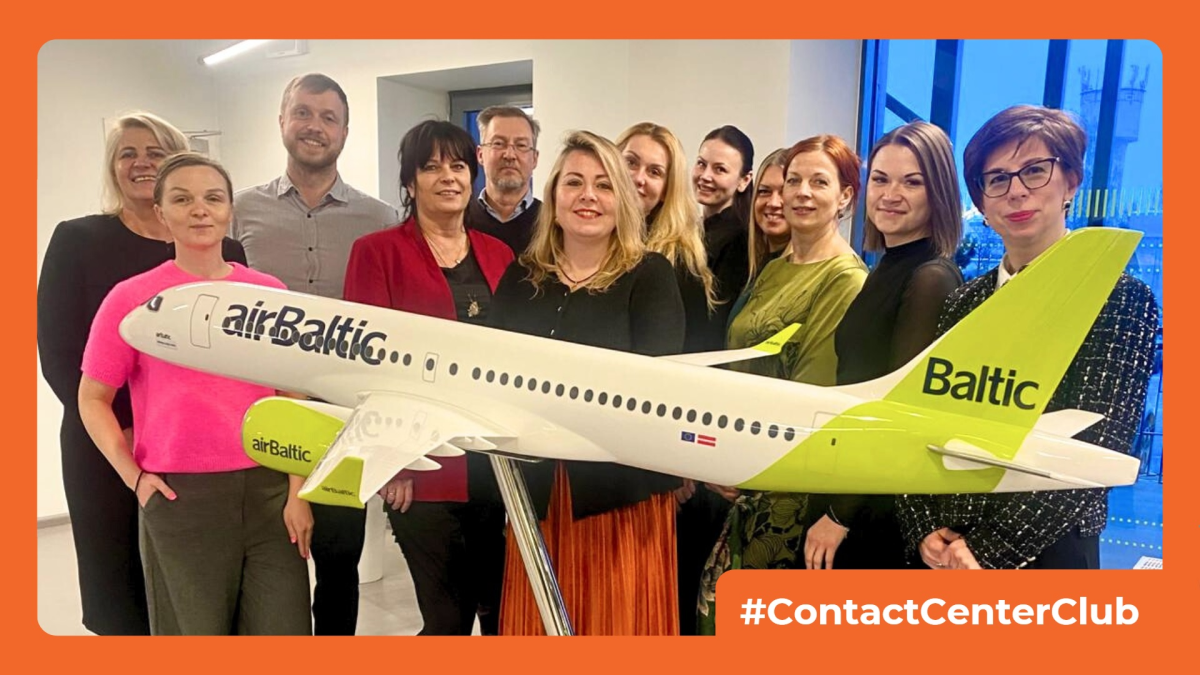
2 Years of Contact Center Community: Where Tech Meets Humans
Contact Center Club marks its 2-year anniversary with a visit to airBaltic. Discussions covered AI in contact centers, the balance between technology and human touch in customer service, the role of empathy, and practical CX solutions for leaders.
Read more
New Genesys “2026 Buyer’s Guide for AI and CX”
The new Genesys “2026 Buyer’s Guide for AI and CX” highlights the AI, automation and CX technologies that will shape contact centers in 2026. Discover 6 essential innovations, assess your readiness for AI solutions, and get practical ideas to advance your customer experience.
Read more